

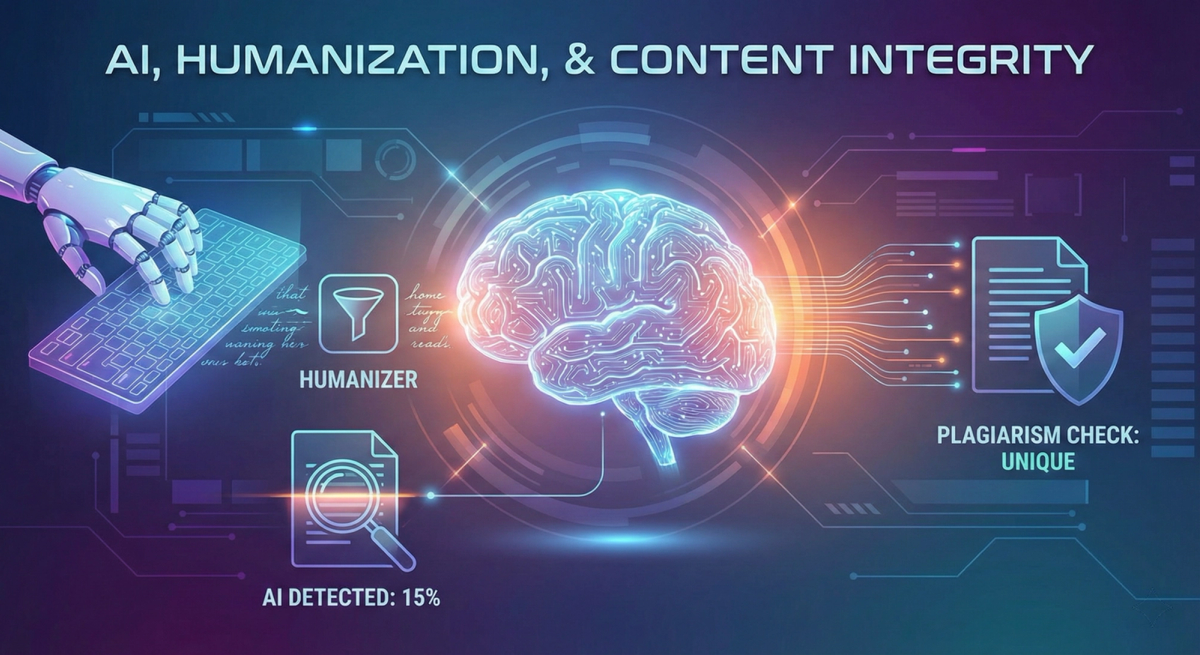
The rapid proliferation and normalization of large language models have permanently altered the digital content landscape. By 2026, artificial intelligence is no longer viewed as a speculative novelty but as a foundational infrastructure deeply embedded within software development, corporate communications, and academic research architectures. However, this normalization has precipitated a complex dialectic between operational efficiency and content authenticity. As digital ecosystems become highly saturated with machine-generated text, a critical secondary industry has emerged to govern content integrity, authenticity, and intellectual property. This industry is anchored by three foundational technological pillars: artificial intelligence content detectors, artificial intelligence humanizers, and advanced semantic plagiarism checkers.
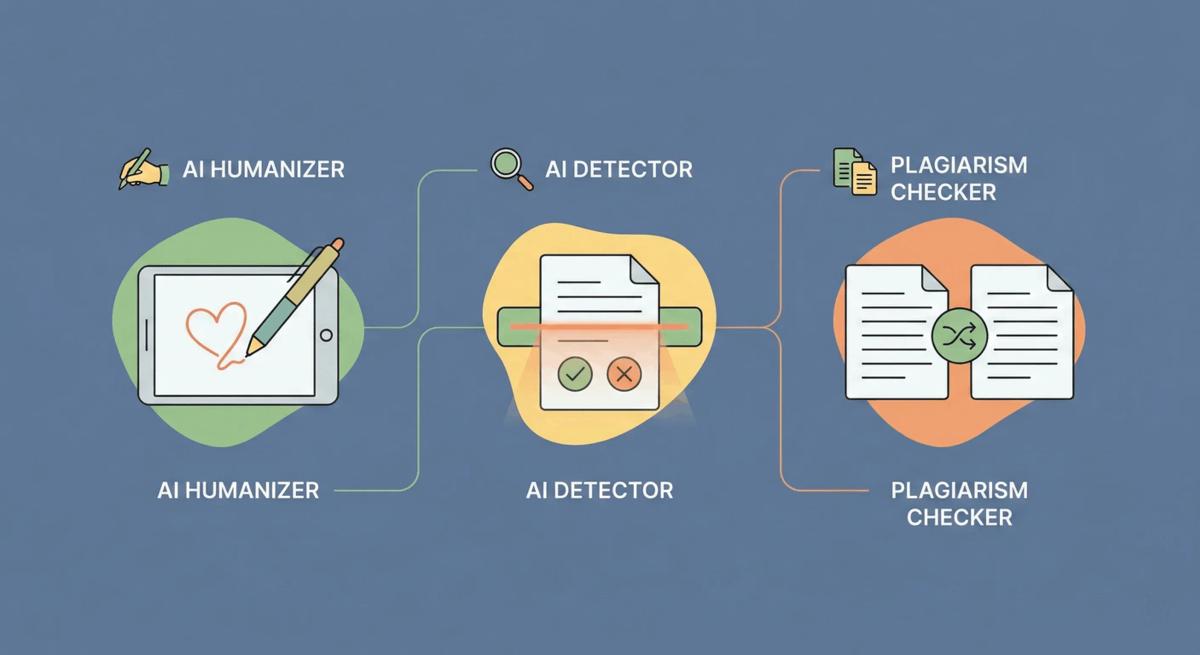
The interplay between these distinct tools constitutes a continuous and escalating technological arms race. Detection systems utilize increasingly sophisticated algorithms to identify the structural, probabilistic, and semantic signatures of machine generation. In direct response, humanization platforms employ adversarial techniques to systematically dismantle those exact signatures, effectively cloaking artificial text within the organic variations of human prose. Concurrently, traditional plagiarism checkers have evolved from simple string-matching utilities into deep-scanning semantic engines, an evolution necessitated by an era where artificial intelligence can effortlessly and instantaneously paraphrase stolen intellectual property.
Platform ecosystems, such as the comprehensive suite offered by AiTurnOut, represent the modern convergence of these discrete utilities. By providing creators, educators, and search engine optimization professionals with unified, secure environments to generate, verify, and deliberately disguise digital content, these platforms serve as the operational nexus of modern digital publishing. This comprehensive report provides a nuanced and exhaustive examination of the artificial intelligence writing verification sector in 2026. It explores the underlying computational linguistics governing text detection and humanization, evaluates market-leading platforms, analyzes strategic workflows for automated content optimization, and investigates the profound ethical and search engine ranking implications of utilizing these controversial technologies.
The Computational Mechanics of Content Verification and Alteration
To understand the efficacy, operational limitations, and strategic applications of modern content tools, it is necessary to examine the underlying mechanisms of text generation, algorithmic detection, and adversarial humanization. Large language models operate on the principle of predictive probability; they generate text by mathematically selecting the most statistically likely subsequent word or token based on the vast linguistic patterns present in their training datasets. This inherent reliance on statistical likelihood produces distinct structural and linguistic signatures that advanced detection systems are explicitly trained to identify.
The Architecture and Efficacy of AI Content Detectors
Modern artificial intelligence content detectors do not perform absolute, cryptographic verification of authorship; rather, they calculate a complex probability estimate regarding the origin of a submitted text. These tools utilize state-of-the-art machine learning algorithms to conduct multi-layered linguistic analyses, meticulously comparing the submitted text against massive datasets containing billions of both human-authored and machine-generated documents.
The detection process relies heavily on evaluating two primary linguistic and statistical metrics: perplexity and burstiness. Perplexity measures the predictability of word choices within a given sentence or paragraph. Because large language models are engineered to be coherent, logical, and structurally sound, they consistently select words with high probabilities, resulting in an output characterized by exceedingly low perplexity scores. Human writers, conversely, frequently utilize unexpected vocabulary, regional colloquialisms, deliberate structural deviations, and diverse phrasing, which yield significantly higher perplexity metrics. Burstiness refers to the variation in sentence length and structural complexity distributed throughout a document. Machine-generated text typically exhibits uniform sentence structures and consistent lengths, creating a monotonous reading rhythm characterized as low burstiness. Authentic human writing is naturally and inherently bursty, fluctuating unpredictably between short, punchy statements and long, complex, compound sentences driven by emotional or argumentative necessity.
Advanced detection platforms are explicitly trained on the diverse outputs of major large language models, including iterative versions of ChatGPT (such as GPT-3.5, GPT-4, and GPT-4o), Claude 3, Gemini, Llama 3, and Jasper, allowing them to recognize the specific algorithmic signatures unique to each model. Beyond the fundamental metrics of perplexity and burstiness, these systems scan for highly specific markers indicative of artificial intelligence authorship. These markers include repetitive transitional phrasing, a uniform lack of emotional depth, the conspicuous absence of specific lived experiences, and predictable, formulaic paragraph structures. When these elements align mathematically, the detector assigns a high probability score indicating artificial intelligence origin.
Despite these advancements, the detection landscape is fraught with inconsistencies. Academic assessments of detection reliability reveal significant fluctuations in accuracy depending on the tool and the nature of the text being analyzed.
| Detection Platform | Accuracy (Kar et al. Assessment) | Accuracy (Lui et al. Assessment) | Key Operational Focus |
|---|---|---|---|
| Turnitin | Not Assessed | 94.00% | Institutional academic compliance, LMS integration. |
| UndetectableAI | 100.00% | Not Assessed | Combines detection with built-in humanization routing. |
| Word Tune | 100.00% | Not Assessed | Stylistic analysis and real-time editing integration. |
| ZeroGPT | 95.03% | 96.00% | Open-access verification for independent creators. |
| Originality.ai |
The data indicates that while detection algorithms are highly sophisticated, they remain probabilistic rather than deterministic. Independent testing and academic research indicate that tools like Originality.ai, while claiming high accuracy rates, remain susceptible to false positives. Frequently, highly technical, dry, or rigidly structured human writing—such as legal documentation, standardized medical reports, or heavily regulated financial disclosures—can be erroneously flagged as artificially generated because human authors in these domains intentionally write with low perplexity and low burstiness. Consequently, industry guidelines in 2026 strictly dictate that detection scores should function as an indicator for further human review rather than absolute proof of machine generation.
The Adversarial Engineering of AI Humanizers
Artificial intelligence humanizers function as sophisticated rewriting algorithms specifically engineered to counter and neutralize the exact metrics evaluated by content detectors. They operate as adversarial networks, accepting machine-generated text as input and algorithmically injecting the specific characteristics of human writing to deliberately bypass sophisticated detection platforms such as Turnitin, GPTZero, and Copyleaks.
The operational mechanics of a high-quality humanizer extend far beyond simple synonym replacement, basic paraphrasing, or the crude "article spinning" prevalent in earlier eras of search engine optimization. Modern platforms leverage highly advanced language models, such as customized generative pre-trained transformers or T5-based neural network models, to execute deep contextual restructuring of the entire document. The primary mathematical objective of the humanizing algorithm is to intentionally and systematically increase the text's perplexity and randomness in a highly controlled manner. This ensures the output becomes mathematically unpredictable to detection scanners while simultaneously maintaining grammatical coherence and preserving the original semantic meaning of the source text.
To achieve this delicate balance, humanizers systematically dismantle uniform sentence structures. The algorithms are programmed to merge short, fragmented sentences, break up excessively long and formal machine-like explanations, and actively reorder information to mimic the spontaneous, non-linear decision-making process characteristic of a human writer. For example, a humanizer will actively scan for and eliminate overly formal tones, robotic cadences, and common artificial intelligence clichés (such as "in today's digital age" or "it is important to note"), replacing them with conversational fillers, varied transitions, deliberate stylistic imperfections, and occasional rhetorical questions.
Some of the most advanced humanizing tools utilize complex two-step processes. In the initial phase, the system swaps vocabulary using context-aware synonym mapping; in the secondary phase, it adjusts the overarching syntax via machine learning to ensure narrative flow. Other platforms employ sophisticated back-translation techniques—translating the text into a secondary language, such as French or Spanish, and subsequently translating it back to the primary language—to introduce organic, natural syntactic variations that effectively mask the original generative algorithm's signature. Furthermore, as detection tools have increasingly begun relying on hidden structural watermarks integrated into artificial intelligence text by the original developers, humanization technology has evolved to actively strip these hidden cryptographic patterns, fundamentally altering the foundational structural identity of the document.
The Unwavering Imperative of Plagiarism Verification
While the contemporary digital discourse in 2026 heavily centers on the dichotomy of artificial intelligence generation and algorithmic detection, the plagiarism checker remains a foundational, distinct, and highly necessary tool for content governance. The fundamental distinction between these technologies is vital for institutional administrators and corporate compliance officers to understand. Artificial intelligence detectors analyze predictive mathematical patterns and structural syntax to formulate a probability regarding the origin of a text. Plagiarism checkers, conversely, operate on the principle of absolute verification against established external databases.
Modern plagiarism detection engines represent a massive leap in computational power. These systems utilize deep scanning technology to crawl the internet in real-time, accessing and indexing billions of web pages, digitized books, academic journals, archived historical pages, and highly restricted institutional databases. During the scanning process, these systems do not merely look for exact keyword matches; they analyze sentence structures and match complex phrase strings to identify direct copies. More importantly, advanced plagiarism checkers possess deep semantic analysis capabilities designed to identify subtle instances of duplication, complex mosaic plagiarism, and highly sophisticated paraphrasing executed by both humans and artificial intelligence models.
The operational distinction between these tools highlights why they must be deployed sequentially. A document generated entirely by a standard large language model will frequently pass a traditional plagiarism check with a perfect, one-hundred-percent originality score, as the language model statistically generates entirely unique combinations of words rather than directly copying existing text from a source database. Conversely, a highly researched, thoroughly human-written document that contains improperly cited research or heavily borrowed concepts will effortlessly pass an artificial intelligence detector but will trigger severe, undeniable warnings on a comprehensive plagiarism report. Therefore, comprehensive content verification necessitates the simultaneous and integrated deployment of both artificial intelligence detection and traditional plagiarism scanning technologies.
AiTurnOut: A Comprehensive Platform Analysis
The marketplace for content optimization tools has decisively shifted toward consolidated platforms that offer end-to-end generation, verification, and refinement services. Single-function applications are increasingly viewed as inefficient. AiTurnOut represents a prominent, market-leading example of this unified architecture, providing an all-in-one toolkit specifically designed for writing optimization, originality verification, and comprehensive media productivity. An in-depth analysis of its core offerings reveals significant analytical deductions regarding the operational demands of modern digital professionals.
The Core Textual Optimization Suite
The flagship application within the AiTurnOut ecosystem is the AI Humanizer. Explicitly designed to transform robotic, predictable text generated by leading models like ChatGPT, Gemini, Claude, and DeepSeek into fluid, expressive, and authentically human prose, the tool focuses on refining drafts to seamlessly bypass advanced detection platforms. The operational process is highly streamlined to maximize user accessibility and throughput. Content is pasted directly into a web-based text editor, where users are prompted to select specific readability levels—ranging from basic high school comprehension to advanced academic prose—and intended narrative purposes before initiating the humanization process. The underlying algorithm typically completes highly complex structural restructuring requests within a rapid window of ten to thirty seconds, rendering an output that actively reduces the probability of triggering alarms on stringent platforms such as Turnitin or GPTZero.
Notably, the platform offers robust multi-language processing, seamlessly handling texts in English, Spanish, and French. This multi-lingual capability serves a rapidly growing demand for international search engine optimization and globalized content marketing, ensuring that linguistic nuance and cultural context are not lost during the algorithmic humanization process. AiTurnOut operates on a highly accessible freemium model, permitting free users to process up to 2,000 words per single request without software installation, while premium subscription tiers provide priority algorithmic processing for extensive enterprise-level projects and faster output generation. To ensure workflow continuity, the humanized content can be immediately exported into various professional formats, including PDF, HTML, Markdown, and plain text, while adhering to strict privacy protocols that ensure content is processed in real-time and never permanently stored on external servers.
Complementing the humanizer is the AiTurnOut AI Content Detector. This proprietary system boasts a remarkable 99.2 percent accuracy rate, a metric achieved through extensive machine learning training across millions of human and machine-authored documents. Utilizing deep linguistic analysis encompassing complexity, perplexity, and burstiness, the detector evaluates input text against the known generative parameters of the latest large language models. It provides users with a highly detailed probability score regarding the text's origin, bypassing simple keyword matching to identify the subtle, underlying markers of machine writing. Crucially, the platform features a closed-loop ecosystem design; if the submitted content is flagged as artificially generated, the interface seamlessly suggests routing the offending text directly through the integrated AI Humanizer, creating a frictionless workflow for immediate content refinement.
The third foundational pillar of the text verification suite is the integrated Plagiarism Checker. This deep-scanning utility provides highly comprehensive post-scan reports detailing percentage originality scores, explicitly highlighted text matches, and direct hyperlinks to the specific source URLs or academic databases where matches were found, thereby allowing users to perform immediate citation verification. By integrating the plagiarism checker alongside the artificial intelligence detector, AiTurnOut allows users to conduct simultaneous, parallel checks for both traditional intellectual property theft and modern machine generation patterns, ensuring a holistic, unassailable view of document integrity before publication or academic submission.
Multimodal Asset Curation and Media Utilities
Beyond its highly sophisticated text manipulation capabilities, the AiTurnOut ecosystem includes an extensive suite of media productivity tools. While these tools appear ostensibly disconnected from the primary function of text verification, their inclusion reveals a deep, strategic understanding of modern content creation workflows. The platform hosts dedicated, high-speed downloaders for a vast array of digital platforms, including YouTube, Instagram, Facebook, TikTok, Twitter, Pinterest, and Reddit.
The Reddit Video Downloader, for example, exemplifies the platform's focus on user friction reduction. It operates as a fast, unlimited web-based utility that automatically integrates audio with high-definition video files—a notoriously difficult task when extracting media from Reddit's native hosting environment (v.redd.it). This allows meme curators, marketers, and researchers to build personal archives of viral content for offline viewing or cross-platform distribution without the need for browser extensions or software installations. Similarly, the platform provides specialized utilities to remove watermarks from TikTok videos and clean visual assets for Pinterest and Twitter.
Further augmenting the visual suite is the Gemini Watermark Eraser, a highly advanced utility that utilizes three distinct artificial intelligence models working in tandem. When processing an image or video, the first model meticulously detects the precise boundaries of the watermark or timestamp. The second model analyzes the surrounding pixel structures, texture patterns, and color gradients. The third generative model seamlessly reconstructs the obscured area, ensuring a natural visual result that avoids the crude blurring or cropping typical of legacy editing tools. For video processing, the tool maintains strict temporal consistency across individual frames to prevent visual flickering or algorithmic artifacts, completing the entire eradication process in under ten seconds.
Target Demographic and Brand Positioning
The inclusion of visual media tools within a primarily text-centric platform highlights a vital secondary analytical deduction regarding the target demographic. AiTurnOut's expansive user base—comprising over one million active professionals, including search engine optimization specialists, e-commerce managers, academic researchers, and digital publishers—requires multi-modal content curation capabilities. Modern digital publishing demands not only authentic, human-sounding written articles that can evade search engine spam filters but also high-quality, unbranded, and legally clean visual assets to accompany the text.
The platform is actively utilized by a highly prestigious cross-section of global institutions, including major universities such as Stanford, Harvard, Northeastern, Duke, and Purdue, as well as tier-one publishing organizations like The New York Times, The Guardian, Reuters, and Business Insider. Corporate entities such as Walmart and AT&T rely on the suite for refining product pages and marketing copy. By consolidating text humanization, deep plagiarism scanning, and frictionless video acquisition into a single, highly secure, browser-based platform, AiTurnOut successfully positions itself as a centralized command center for holistic digital content production. The brand voice further solidifies this market positioning, consistently emphasizing authentic, human-centric prose, lightning-fast processing efficiency, and absolute search engine optimization dominance.
Comparative Ecosystem Analysis: Market Alternatives in 2026
While consolidated platforms like AiTurnOut offer unparalleled workflow convenience, the broader landscape of artificial intelligence detection and humanization in 2026 remains highly fragmented. The market features numerous specialized competitors catering to highly distinct market segments, ranging from academic compliance officers to rogue affiliate marketers. An evaluation of these alternatives demonstrates vastly varying approaches to accuracy, pricing structures, and specific technological feature sets.
The following table provides a comprehensive structural comparison of leading artificial intelligence detection and humanization tools available in 2026, categorized by their core competencies, primary target demographics, and distinct technological differentiators.
| Platform Designation | Primary Competency | Target Demographic | Key Technological Differentiators & Pricing Structures |
|---|---|---|---|
| AiTurnOut | Unified Multi-modal Ecosystem | SEO professionals, global creators, university students | Integrates a humanizer, a 99.2% accurate detector, deep plagiarism scanning, and media/watermark removal tools. Free tier generously supports up to 2000 words per generation. |
| Grammarly | Integrated AI editing agents | Corporate professionals, enterprise teams, general writers | Focuses on establishing customized brand tones, built-in AI assistance, and seamless browser integration. It does not prioritize aggressively bypassing external detectors, but rather improving baseline fluency. |
| Originality.ai | High-precision commercial detection | Publishing networks, SEO content agencies, enterprise webmasters | Highly aggressive detection billed as the industry's most accurate (80%+ tested accuracy). Operates strictly on a pay-as-you-go credit system ($12.95 per 2,000 credits). Explicitly lacks a native humanizer. |
This comparative analysis reveals highly significant underlying market trends and diverging philosophies regarding content governance. Platforms such as Originality.ai, Copyleaks, and Proofademic focus almost entirely on the defensive posture of detection. These tools serve agencies, educational institutions, and publishers seeking to protect their internal ecosystems from low-quality, heavily automated machine submissions. These defensive tools prioritize high sensitivity, occasionally accepting the risk of false positives to ensure no generated content slips through the institutional perimeter.
Conversely, tools like GPTHuman and StealthWriter operate aggressively on the offensive, catering specifically to end-users who are actively attempting to bypass those very defensive systems to maximize their personal or commercial output. Comprehensive suites such as AiTurnOut bridge this inherent market divide by offering both defensive verification and offensive humanization capabilities within the same architecture, allowing a user to rigorously audit and refine their own content before subjecting it to external institutional submission. Furthermore, established, legacy grammar tools like Grammarly have pivoted to deeply embrace artificial intelligence, offering native humanizers designed not necessarily to evade academic detectors, but to align rough machine drafts with highly customized, authentic user voices and corporate brand style guidelines.
To navigate this fragmented ecosystem, professionals frequently adopt scenario-based tool selections, utilizing distinct combinations of software depending on the specific output requirements.
| Professional Scenario | Recommended Primary Tool | Recommended Secondary Verification | Strategic Rationale |
|---|---|---|---|
| University Essay Submission | GPTinf (or AiTurnOut) | Copyleaks / Winston AI | Requires deep humanization to bypass stringent academic scrutiny, followed by heat-map verification to ensure safety. |
| SEO Agency Content Scaling | AiTurnOut | Originality.ai | Demands rapid, bulk humanization coupled with the industry's most aggressive commercial detector to ensure content is unassailable by Google algorithms. |
| Corporate Brand Publishing | Sapling | Grammarly | Prioritizes tone consistency, brand voice alignment, and fluent readability over aggressive detector evasion. |
Strategic Workflow Integrations for Automated Content Pipelines
The isolated utilization of a single content tool is increasingly rare, and largely ineffective, in professional environments. In 2026, extreme operational efficiency and stringent risk mitigation dictate that writers, search engine optimization teams, and academic students employ highly structured, multi-layered workflows. These pipelines seamlessly integrate initial generation, deep humanization, probabilistic detection, and semantic plagiarism scanning into cohesive, automated systems.
The Academic Verification Workflow
For high-stakes environments such as university submissions or peer-reviewed academic journals, the standard workflow prioritizes meticulous verification to avoid catastrophic academic integrity violations. This manual process is designed to proactively mimic the rigorous, multi-layered scrutiny of an institutional reviewer or a thesis advisor.
A standard multi-tool academic verification workflow begins immediately following the generation of an initial draft. The user must first run the document through a primary, highly sensitive institutional scanner. This frequently involves utilizing a student-accessible preview of Turnitin via a university learning management system or employing a specialized academic tool like Paper-Checker. If the document yields an artificial intelligence probability score below a baseline threshold of fifteen percent, it is generally considered safe for submission. However, if the score is elevated, the student must engage in a secondary scan using an independent commercial platform like Originality.ai to analyze hybrid content—text consisting of intricately woven human and machine input.
A tertiary check using a platform like ZeroGPT or GPTZero may follow to evaluate specific, sentence-level probabilities and isolate the exact phrases triggering the algorithms. If the average probability score across these platforms indicates a high likelihood of machine generation, the student must manually revise the text or employ an academic-focused humanizer to aggressively increase syntactic burstiness and inject highly personal, contextual insights. Following these critical revisions, the document is immediately submitted to a traditional plagiarism checker to ensure that no external source material was improperly paraphrased during the humanization process. Throughout this entire workflow, the meticulous documentation of edits within word processing software—utilizing "Track Changes"—is highly advised to provide a clear, undeniable audit trail of human effort in the event of a false positive accusation from a university administrator.
The Search Engine Optimization and Corporate Publishing Pipeline
Content marketing agencies, digital public relations firms, and high-volume bloggers face entirely different operational pressures, prioritizing massive scale, rapid deployment speed, and strict search engine algorithmic compliance. For these professionals, the integration of advanced automation platforms, such as Zapier or Make (formerly Integromat), is paramount to business survival.
An advanced corporate publishing workflow in 2026 relies almost entirely on seamless backend automation. The process is initiated the moment a writer or an artificial intelligence agent submits a completed draft to a centralized content management system or a designated Google Document. This submission acts as a digital trigger, prompting a Zapier integration to automatically route the text via application programming interfaces (APIs) directly to a designated artificial intelligence detection tool.
If the text exceeds a predetermined, agency-defined threshold for machine generation (e.g., scoring above thirty percent artificial intelligence probability), the automation sequence immediately and autonomously pushes the document into an artificial intelligence humanizing tool. The humanizer executes predefined tonal adjustments to autonomously restructure the syntax, break up monotonous phrasing, and elevate the perplexity metric. Simultaneously, a parallel automated sequence routes the text through a plagiarism scanner. The final synthesized data—including the newly humanized text, the updated detection scores, and the comprehensive originality report—is automatically populated into a project management dashboard, such as Trello or Asana, thereby alerting a senior human editor that the document is finally ready for a manual, qualitative review.
Industry case studies demonstrate that the implementation of these automated, multi-step verification pipelines can reduce administrative review time by up to seventy percent. This massive efficiency gain enables marketing teams to scale content operations across dozens of decentralized writers while rigorously upholding strict brand integrity standards. However, elite search engine optimization experts strongly caution against total, unquestioning reliance on this automation. The most successful and sustainable publishing workflows emphasize a process of iterative generation—prompting the language model to create content one small section at a time to prevent the algorithm from losing context or engaging in repetitive linguistic hallucinations. This iterative generation must be followed by strategic manual refinement to ensure the resulting prose reflects genuine lived experience, emotional resonance, and stylistic nuance that no current automation can fully replicate.
Search Engine Optimization and the 2026 Google Algorithmic Paradigm
A central, driving force behind the massive commercial proliferation of artificial intelligence humanizers is the persistent, industry-wide anxiety regarding search engine algorithmic penalties. The complex relationship between machine-generated content and Google's organic search rankings has been a subject of intense scrutiny, debate, and testing, culminating in highly significant algorithmic adjustments, most notably the sweeping January 2026 Core Update.
A critical, deeply entrenched misconception pervades the digital marketing industry: the prevailing belief that Google explicitly bans, actively hunts, or inherently penalizes artificial intelligence content based solely on its origin. Official communications from Google Search Central, statements from search advocates like John Mueller, and extensive empirical testing by technical search engine optimization professionals definitively confirm that Google evaluates content based almost entirely on its inherent value and helpfulness to the user, not its specific method of production. The search engine utilizes vastly sophisticated ranking systems designed to identify and disproportionately reward high-quality, reliable information that satisfies the core evaluative tenets of Experience, Expertise, Authoritativeness, and Trustworthiness (E-E-A-T).
Therefore, the highly publicized January 2026 Core Update functions not as a targeted, punitive strike against artificial intelligence as a technology, but as an aggressive, necessary filter against low-effort, mass-automated content that provides absolutely no original insight, empirical analysis, or additive value to the digital ecosystem. Large language models, by their fundamental statistical nature, can only synthesize and regurgitate existing, previously published information. Without deliberate human intervention and stylistic guidance, this raw output is frequently characterized by search professionals as "clean but empty"—grammatically flawless, structurally sound text that completely lacks unique perspectives, proprietary empirical data, or definitive, defensible opinions. When digital publishers utilize artificial intelligence to lazily mass-produce this generic material in a transparent attempt to manipulate search rankings, the algorithms easily detect the profound absence of genuine user value and subsequently suppress the content's visibility, effectively burying it in the search results.
This harsh algorithmic reality underscores the immense strategic necessity of artificial intelligence humanizers. The objective of humanizing text for search engine optimization purposes is not strictly to deceive Google's internal detection algorithms—as Google's web crawlers index machine and human text identically without inherent prejudice—but rather to modify the cadence and structure of the content so it deeply resonates with human readers. Humanizers actively break the monotonous rhythm of raw artificial intelligence output, significantly improving readability, narrative flow, and engagement. When human readers encounter engaging, naturally flowing prose that feels authentic, they remain on the webpage significantly longer, thereby reducing bounce rates and sending powerful behavioral signals to the search engine that the content has successfully and comprehensively satisfied the user's initial search intent.
To achieve and maintain sustainable organic rankings in the highly volatile environment of 2026, content creators must adopt a rigorous hybrid methodology. Artificial intelligence serves as a highly efficient, indispensable tool for extensive brainstorming, structural outlining, and rapidly drafting preliminary concepts. However, the subsequent refinement and humanization phase is absolutely non-negotiable. Writers must utilize algorithmic humanizers to correct structural cadence and eliminate robotic phrasing, while simultaneously taking on the responsibility of manually injecting industry-specific data, proprietary screenshots, highly personal anecdotes, and definitive professional judgments into the text. By seamlessly bridging the massive gap between automated generation efficiency and authentic, verified human insight, this hybrid methodology ensures strict compliance with Google's helpful content mandates and robustly safeguards organic web traffic against future algorithmic volatility.
Ethical Considerations and Academic Integrity Governance
While corporate marketers leverage humanizers for commercial gain, the widespread adoption of these technologies has precipitated profound ethical dilemmas and philosophical debates, particularly within academic institutions and scholarly publishing environments. In university settings, where intellectual integrity, the cultivation of original thought, and the rigorous development of authentic analytical skills are paramount, the use of algorithms designed specifically to bypass detection systems creates a fundamental, existential crisis of academic assessment.
When students rely on humanizers to deliberately obscure the origin of their submissions, they directly undermine the foundational pedagogical objectives of higher education. Academic institutions rightfully argue that an over-dependence on these masking tools severely impedes a student's development of critical thinking, analytical reasoning, and independent communication capabilities. The ethical breach, in the eyes of modern academia, is not necessarily the use of artificial intelligence for initial brainstorming, structural assistance, or grammatical correction; the profound violation occurs when a student generates an entire thesis or research paper using a language model and subsequently employs a humanizer to actively camouflage their total lack of intellectual effort. This deliberate masking of authorship is universally classified as severe academic dishonesty, regardless of whether the modified text successfully evades the university's detection software.
Furthermore, the deployment of algorithmic humanizers in advanced academic, medical, and scientific writing introduces severe, tangible risks regarding factual accuracy and semantic precision. Scholarly communication requires absolute exactitude. Automated humanizers, which inherently prioritize structural variation, synonym swapping, and perplexity enhancement over scientific nuance, may inadvertently alter crucial technical terminology, neutralize critical qualitative qualifiers, or subtly shift the fundamental emphasis of empirical claims in order to achieve a "human" score. In disciplines such as molecular biology, legal studies, or nephrology, where absolute precision is a matter of professional safety and ethical compliance, such undetected algorithmic alterations can severely damage the credibility of the research and lead to dangerous real-world consequences.
To successfully navigate this complex ethical landscape, leading academic institutions in 2026 are rapidly transitioning away from the futile policies of absolute prohibition toward frameworks of managed, highly regulated integration. A vast majority of forward-thinking universities now operate under "AI-inclusive" frameworks, mandating absolute procedural transparency. These updated guidelines explicitly require students and researchers to formally disclose any artificial intelligence assistance—including the specific use of both generation and humanization tools—in strict accordance with updated APA and MLA 2026 citation standards and university mandates, such as Purdue University's AI competency requirements.
Progressive educators are actively encouraging students to utilize tools like AiTurnOut's detector defensively—scanning their own independently written work prior to formal submission to ensure their natural, highly structured academic writing voice does not inadvertently trigger false positive alarms in the professor's grading software. Ethical integration inherently relies on a philosophical reframing of artificial intelligence: viewing it as a collaborative digital entity, akin to a highly advanced calculator or a digital pen, rather than an autonomous ghostwriter.
Advanced prompt engineering techniques, such as the C.A.R.E. framework (Context, Audience, Role, and Examples), are now formally taught to generate highly specific, context-aware initial drafts that naturally possess a human tone without requiring deceptive post-processing. When these frameworks are utilized, the ethical burden seamlessly shifts from attempting to bypass detectors to engaging in genuine manual humanization—the deliberate, manual injection of unique insights, critical analysis, and varied sentence structures—rendering the use of deceptive software humanizers entirely unnecessary for the honest student. Ultimately, achieving and maintaining academic integrity in the modern technological era requires a massive collaborative effort: software developers must responsibly market their tools as refinement aids rather than cheating mechanisms, academic institutions must fundamentally adapt their evaluation methodologies to assess critical reasoning rather than mere output generation, and individual users must claim ultimate, unwavering responsibility for the absolute accuracy of their submissions.
Future Trajectories: Agentic Workflows and Regulatory Compliance in 2026
As the global digital ecosystem moves deeper into 2026, the underlying technologies governing content generation, detection, and humanization are poised for exponential, highly disruptive evolution. The future landscape will be fundamentally defined by the rise of intelligent automation, significantly enhanced governmental regulatory oversight, and a profound shift in how both individuals and massive organizations interact with artificial intelligence infrastructure.
A primary, unavoidable catalyst for this evolution is the rapid emergence and deployment of agentic artificial intelligence. Moving far beyond the responsive, text-box chat interfaces of previous years, agentic systems possess the native capacity to autonomously plan, critically reason, and execute complex, multi-step workflows with almost zero human supervision. As highlighted by Microsoft executives such as Aparna Chennapragada and Vasu Jakkal, these agentic models are transitioning from simple tools into active, collaborative teammates. Because these systems are becoming highly context-aware and capable of continuous self-learning, the text they generate will inherently reflect deep, personalized alignment with specific human intent and highly nuanced brand voices. Consequently, the baseline generative capability of these models will soon bypass current detection parameters entirely, rendering probability-based detection obsolete and forcing a massive paradigm shift in how digital originality is verified.
This shift is heavily corroborated by data from the software testing and quality assurance industries. According to extensive analysis by industry leaders, based on data from over 40,000 active testers, 72.8 percent of testing professionals now prioritize artificial intelligence integration, yet paradoxically do not trust it to operate independently. The emergence of concepts such as "vibe testing"—evaluating the nuanced, human-like resonance of an AI output—and the deployment of Model Context Protocols (MCPs) indicate that the focus is shifting away from simple syntax verification toward deep qualitative assessment. In this environment, the role of the quality assurance professional is morphing into that of an "AI auditor" or "quality strategist," reflecting the intense complexity of managing agentic outputs.
Simultaneously, the global regulatory environment is adapting rapidly, forcefully reacting to this technological acceleration. A critical milestone profoundly shaping 2026 is the strict enforcement of the European Union Artificial Intelligence Act, which formally went into effect in March 2025. This landmark legislation explicitly mandates that all artificially generated content available within the European market must be clearly and unequivocally labeled, utilizing deeply embedded detectable signals, unalterable metadata indicators, or sophisticated cryptographic watermarks.
This legislative requirement fundamentally and permanently disrupts the current, syntax-based dynamic between content detectors and humanizers. Historically, humanizers successfully evaded detection by merely altering syntactic patterns, swapping synonyms, and increasing burstiness. However, as massive generation platforms comply with strict international law by embedding highly complex cryptographic structural watermarks deeply into their outputs, detection platforms will pivot away from probabilistic linguistic analysis and move entirely toward definitive, binary cryptographic verification. In direct response to this regulatory environment, adversarial humanizers and highly specialized utilities—such as advanced watermark erasers—will increasingly be utilized to actively, and potentially illegally, strip these legally mandated compliance signals. This transition escalates the technological arms race from a relatively benign battle over syntax and grammar into a highly complex, high-stakes legal and cryptographic conflict regarding digital provenance.
Furthermore, as predicted by technology analysts like Sinead Bovell, the cultural reaction to ubiquitous artificial intelligence will deeply influence content consumption patterns. The anticipated rise of consumers choosing to be intentionally "offline," coupled with the proliferation of voice-first technology and AI-integrated wearable glasses, indicates that text-based content must become exceptionally high-quality and undeniably human to capture dwindling attention spans. Within organizational environments, the approach to artificial intelligence is rapidly transitioning from individualized, ad-hoc tool usage to centralized, highly regulated enterprise-level governance. Transparency and explainability have become absolute mandates for Chief Information Officers. Rather than relying on individual employees to manage their own humanization and detection workflows, corporations will increasingly deploy massive, unified ecosystem solutions that continuously monitor content origin, verify originality, and ensure strict stylistic and legal compliance at the network level. In this hyper-automated environment, the ultimate value of human interaction shifts entirely from the tedious act of primary drafting to the sophisticated curation, ethical validation, and strategic direction of these automated systems.
Conclusion
The complex intersection of artificial intelligence generation, algorithmic detection, and adversarial humanization represents one of the most dynamic, consequential, and rapidly evolving technological developments of 2026. As large language models attain entirely unprecedented levels of fluency, coherence, and speed, the fundamental ability to reliably discern authentic human expression from highly optimized machine efficiency has become a critical operational requirement across higher academia, corporate content marketing, and global digital publishing.
The extensive analysis within this report indicates that the current landscape is fundamentally defined by a cyclical, highly sophisticated adversarial relationship. Detection platforms employ highly advanced statistical metrics, such as perplexity and burstiness analysis, to identify the predictive, mathematical nature of language models. In immediate, automated response, humanization tools utilize complex neural networks and restructuring algorithms to artificially inject the chaotic, unpredictable variability inherent in human thought, thereby systematically eroding the efficacy of the defensive detectors. Concurrently, traditional, deep-crawling plagiarism checkers remain absolutely indispensable, providing the only empirical verification of true source originality in an online environment where concepts and ideas are effortlessly synthesized, paraphrased, and repurposed by machines in milliseconds.
Comprehensive, multi-modal platforms like AiTurnOut powerfully demonstrate the modern market's intense demand for consolidated digital ecosystems. By providing users with the requisite tools to simultaneously verify originality, assess complex detection probabilities, flawlessly humanize synthetic prose, and curate unbranded multimedia assets within a single, highly secure environment, these platforms have become the operational standard for digital creators. The strategic, automated deployment of these integrated workflows—utilizing platforms like Zapier to link generation, detection, and humanization—is no longer an optional luxury for digital professionals; it is a strict operational necessity required to seamlessly scale content production, navigate increasingly stringent institutional integrity policies, and align with highly sensitive search engine algorithms that ruthlessly suppress low-effort, automated content.
Ultimately, the immediate future of digital content does not lie in a zero-sum, adversarial conflict between human endeavor and artificial intelligence capabilities. Google's stringent search engine guidelines and rigorous academic integrity frameworks heavily converge on a singular, undeniable truth: the ultimate value of any content is derived entirely from its factual accuracy, its unique, defensible insight, and its profound alignment with genuine human experience. Artificial intelligence serves as an unparalleled, revolutionary engine for structural efficiency and rapid ideation, but it currently remains incapable of synthesizing genuine lived experience or rendering true moral judgment. The most highly successful and resilient professionals in 2026 and beyond will not be those who blindly automate their output, but rather those who master the sophisticated synthesis of these distinct technologies. They will leverage language models for rapid, structured ideation, deploy rigorous detectors and plagiarism checkers for absolute compliance, and utilize advanced humanizers to facilitate natural, readable communication, all while strictly reserving the final, irreplaceable layer of critical analysis, emotional resonance, and authentic voice for the human author.